
So you've got your first ukulele... now what?
If you're feeling excited and a little overwhelmed, you're not alone. Almost every beginner wonders where to start, especially if you've never played an instrument before.
The good news is that learning the ukulele doesn't have to be complicated. You don't need musical talent, fast fingers, or years of musical experience. You simply need someone to guide you through the right steps in the right order.
I've taught hundreds of adult beginners over the years, and I've found that the people who make the fastest progress aren't necessarily the most musical—they're the ones who take things one step at a time.
In this guide, I'll show you exactly how to start playing the ukulele without feeling overwhelmed.

→ Want an even easier place to begin?
I created a free guide called Your First 5 Songs on Ukulele: Quick Start Guide for Beginners that walks you through the basics while helping you play real songs right away. If you haven't downloaded it yet, I highly recommend grabbing your free copy before you continue. >>Click here<< to download it!

The biggest mistake most beginners make
One of the biggest mistakes I see beginners make is trying to learn everything at once.
They watch a few YouTube videos, learn a couple of random chords, try an advanced strumming pattern, and pretty soon, everything feels confusing.
Learning the ukulele becomes much easier when you build one skill at a time.
First you learn how to hold the instrument comfortably.
Then you tune it.
Then you learn a couple of easy chords.
Then you add a simple strumming pattern.
Before you know it, you're playing your first songs.
That's exactly the approach we'll use here.
Step 1: Get familiar with your ukulele
Before you play your first note, spend a minute getting to know your instrument.
The large wooden section is called the body. The long section is the neck. At the top you'll find the headstock and the tuning pegs.
Most beginner ukuleles are tuned to G-C-E-A. When you're holding the ukulele in playing position, the string closest to your face is the G string, and the string closest to the floor is the A string.
Don't worry about memorizing lots of musical terms right now. Just becoming familiar with your instrument is enough for today.
Step 2: Hold the ukulele comfortably
Good posture makes learning so much easier.
Sit comfortably in a chair and rest the ukulele gently against your body. If you're right-handed, hold the neck with your left hand and strum with your right. Left-handed players can either use a left-handed ukulele or try the standard setup first to see what feels most comfortable.
One thing I often notice is that beginners squeeze the neck much harder than they need to. Try to keep your hands relaxed. Your fretting hand guides the neck—it doesn't need to grip it tightly.
The more relaxed you are, the easier chord changes will become.
Step 3: Tune your ukulele before every practice session
This might not be the most exciting step, but it's one of the most important.
Even if you're playing the correct chord shapes, an out-of-tune ukulele will never sound right.
I recommend using a clip-on tuner or a tuning app before every practice session. After a while, tuning becomes second nature and only takes a minute.
If your ukulele is brand new, don't be surprised if it goes out of tune frequently. New strings stretch quite a bit at first, and that's completely normal.
Step 4: Learn your first two chords
Now for the fun part—you get to start making music!
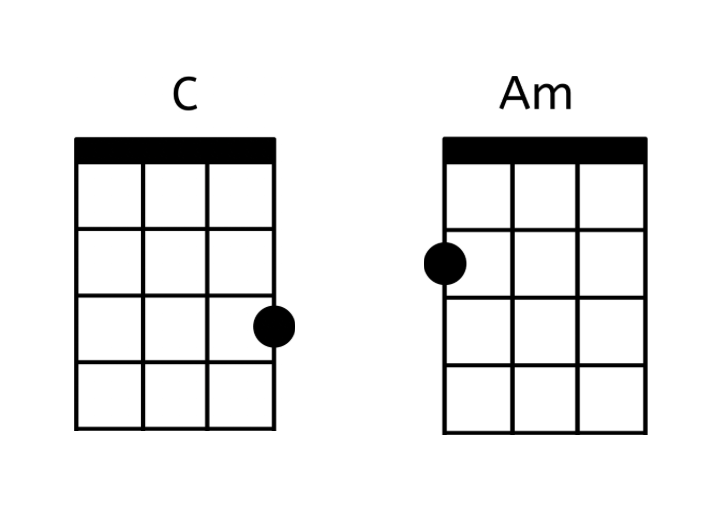
I recommend beginning with C and A minor because they're both easy to play with just one finger.
To play C, place your ring or pinky finger on the third fret of the A string (the string closest to the floor) and strum all four strings with your thumb, index finger or a pick.
To play A minor, place your middle or index finger on the second fret of the G string (the string closest to your face) and strum all four strings.
Take your time moving between these two chords. At first your fingers might feel slow or clumsy—and that's perfectly normal.
Don't worry about speed.
Focus on making each chord sound nice and clear.
Step 5: Add F and G7
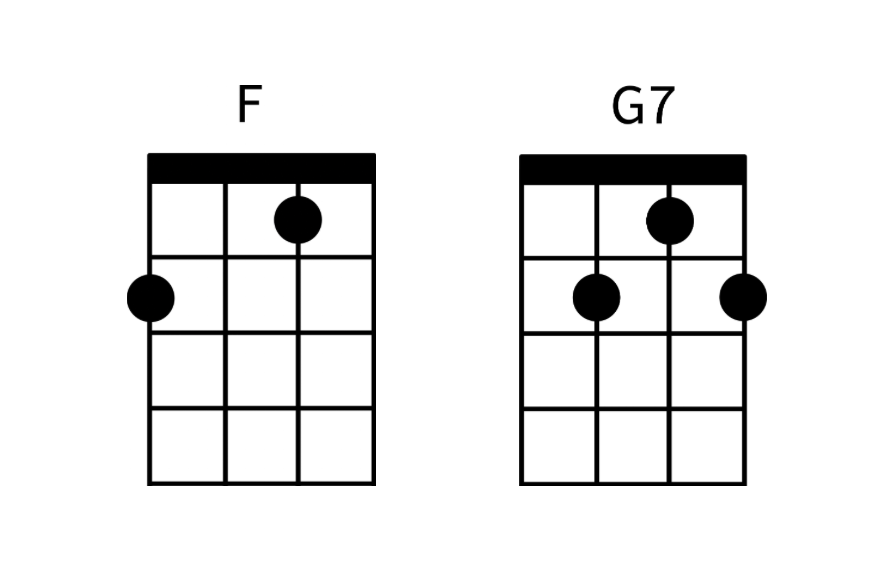
Once C and A minor feel comfortable, you're ready to learn F and G7.
F uses two fingers, while G7 introduces a slightly different hand shape that many beginners find easier than a full G chord.
With just these four chords—C, A minor, F and G7—you'll be surprised how many songs you can already play.
Your fingertips might feel a little sore during your first week or two. That's completely normal as they get used to pressing the strings.
If you ever feel sharp pain, though, stop and check your hand position. Often it's just a matter of relaxing your wrist or pressing a little less firmly.
Step 6: Keep your strumming simple
Many beginners think they need to learn fancy strumming patterns right away.
You definitely don't! That will come with time.
A steady down strum is enough to play hundreds of songs.
Count 1-2-3-4 and strum down once on each beat.
Try to keep your wrist relaxed and use a light touch. The ukulele doesn't need a lot of force to create a beautiful sound.
Once that feels comfortable, you can gradually experiment with simple patterns with down and up strums.
There's no rush.
A simple rhythm played steadily always sounds better than a complicated rhythm that's rushed.
Step 7: Practice changing chords
This is where everything starts coming together.
Choose two chords—for example, C and A minor—and switch between them every four beats.
If you have to pause between chord changes, that's okay.
Every beginner does.
As you continue practicing, those pauses will naturally become shorter.
One little tip I often give my students is to keep their fingers close to the strings instead of lifting them high into the air. Smaller movements make faster chord changes.
Step 8: Play your first song
As soon as you know C, A minor, F and G7, you're ready to start playing real songs.
This is one of my favourite moments to see with new students.
There's something really exciting about realizing you can play music after only learning a few chords.
Choose a simple song with slow chord changes (like This Little Light Of Mine or Happy Birthday) and stick with it for a few days.
The first time you play all the way through—even if it's not perfect—you've reached a huge milestone.
Celebrate it!
How to improve faster
You don't need to practice for hours every day.
It's much better to practice for 10–15 minutes every day than spend an hour practicing once a week.
Short, consistent practice sessions help your fingers build muscle memory while keeping learning enjoyable.
A simple practice routine might look like this:
Tune your ukulele.
Review yesterday's chords.
Practice some chord changes with simple down strums.
Finish by playing a couple songs you enjoy.
That's more than enough to make steady progress.
Don't worry if...
If your strings buzz, don't panic. Usually your finger just needs to move a little closer to the fret or press down a little more firmly.
If a note sounds muted, another finger is probably touching the string by accident.
And if changing chords feels slow...
Welcome to being a beginner!
Every ukulele player has gone through exactly the same thing.
Learning the ukulele is a physical skill, and your hands simply need time to build new muscle memory. Keep practicing, and you'll be amazed at how much easier everything feels in a few weeks.
What's next?
Once you're comfortable with a few chords and songs, you can start exploring new strumming patterns, fingerpicking, barre chords and even chord melodies.
But don't feel like you have to learn everything right away.
I've found that adult beginners make the most progress when they focus on one new skill at a time and enjoy each small success along the way.
If you'd like someone to guide you step by step, I'd love to help.
My Ukulele Course for Total Beginners is designed especially for adults who are starting from scratch. You don't need any musical experience, and I'll show you exactly what to practice next so you can build confidence without feeling overwhelmed.
And if you're not quite ready for the full course, be sure to download my free Your First 5 Songs on Ukulele: Quick Start Guide for Beginners. It's a great place to begin and will help you start playing real songs sooner than you might think.
Most importantly, remember to enjoy the journey.
Every ukulele player starts with that very first chord. Be patient with yourself, take one step at a time, celebrate your progress, and before long you'll be playing songs you never thought possible.